

The Daily Observer London Desk: Reporter- Judith Benjamin
Antonio Vacca can remember the moment well.
In truth, the Italian is unlikely to forget it anytime soon, given he not only gets to see his “little theory put into practice” every time he watches Brighton & Hove Albion play on television, but he also has Roberto De Zerbi’s initials tattooed on him.
The story Vacca recalls goes back to De Zerbi’s time in charge of the Serie C club Foggia, between 2014 and 2016, and an incident in a training match that fundamentally changed how the Brighton manager viewed build-up play, and, ultimately, contributed to one of football’s modern tactical trends.
As a keen futsal and five-a-side player in his home city of Naples, Vacca developed an instinct to use the sole of his foot as a method of receiving possession. “I found it easier to stop and control the ball that way,” he tells The Athletic.
De Zerbi saw talent and intelligence in Vacca and believed he could play at a higher level, but there were also moments when he found the midfielder’s use of the sole of his foot frustrating. Sometimes De Zerbi would stop training and say to Vacca: “Sorry, if you need the sole, you have to use it. But if you don’t need it, you don’t.”
The practice match in question threatened to be another of those occasions as De Zerbi urged Vacca to shift the ball more quickly, only this time the coach received a response that stopped him in his tracks.
“My team-mates on the opposing side weren’t stepping out to press me, so the Mister (coach) kept telling me: ‘Pass it, move it’,” Vacca explains. “So I replied: ‘Mister, if our opponents on Sunday come here and play for a point and I move it without getting one of them to jump and press the ball, it’s no use’.
“I argued that if I put the sole of my foot on the ball and lured my opponent out, I’ve invited him to press me. As he does that, we can break the line with a pass.”
Some coaches could react negatively to a player disagreeing with them on the training pitch and making a tactical suggestion, but that was never De Zerbi’s way. Vacca and others would spend hours in the coach’s office talking tactics.
“People who don’t know him might have another idea, but he’s really humble and a footballer can tell him anything,” Vacca says. “He’s the one who has the final say, but when you say something to him, he’ll go away and think about it.
“I remember the following day he said, ‘Vacca’s right. When our opponents sit back, we need to put the sole of the foot on the ball and get them to come out, provoke them, because when a player sees you standing on the ball like that, it sparks something inside them’.”
Many years later, during a two-hour webinar, De Zerbi credited Vacca with opening his eyes to the tactical value of using the sole of the foot as a means of inviting pressure and giving him one of his core build-up principles as a coach.
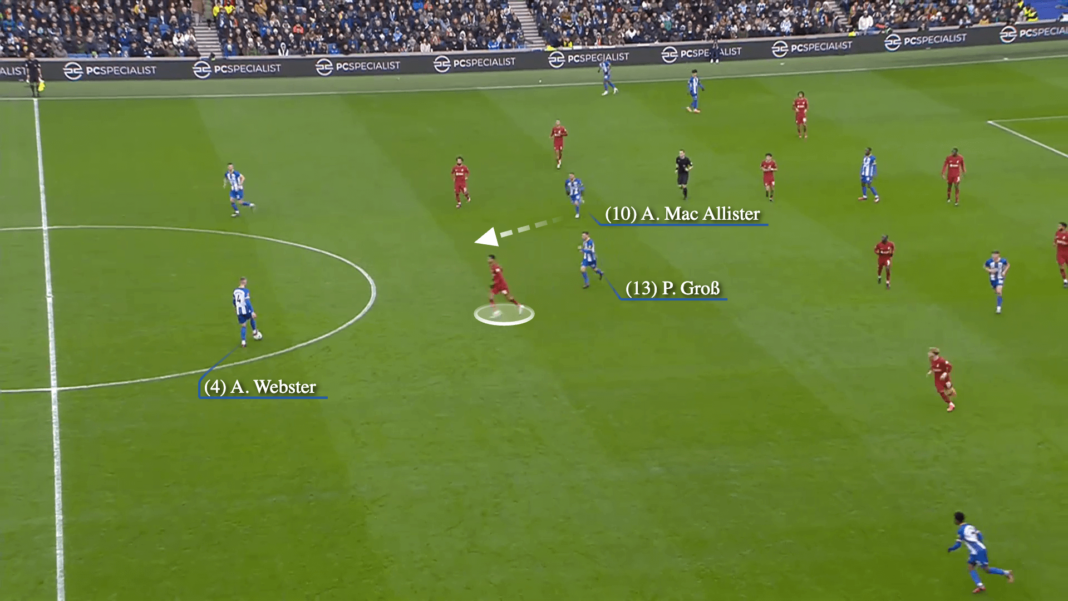
The images below, which are taken from Brighton’s FA Cup tie against Liverpool last season, illustrate what that looks like.
Adam Webster has his studs on top of the ball, enticing Cody Gakpo (circled) to press. Alexis Mac Allister comes short to offer an option…
… Webster feeds the ball into the midfielder and Pascal Gross (circled) is the free man.

Mac Allister passes inside to Gross and Brighton have worked the triangle perfectly.

Vacca’s influence on De Zerbi feeds into a wider conversation around the increasing use of the sole of the foot in build-up play at other clubs, as well as the tactical game of cat and mouse that often sits alongside it.
Sunday’s Premier League match between Arsenal and Manchester City was a classic example.
When Arsenal goalkeeper David Raya put his studs on top of the ball in the image below, it was the trigger for the City midfielder Rico Lewis (circled) to lead the press. For context, Raya had already received the ball twice from Arsenal defenders in this passage of play (City didn’t always choose to press Raya when he used his sole).

The second of those Arsenal passes back to Raya was made by William Saliba, shown below. You can also see how City’s six-man press is narrow to stop Arsenal from playing through them.

Raya ends up playing a ‘bounce’ pass to Jorginho, with the intention of dragging City’s press further forward and freeing space up elsewhere.
But what’s interesting here is the home supporters’ growing anxiety, which could be heard loud and clear (and it was not fuelled by the moment when Julian Alvarez nearly scored after pressing Raya — that hadn’t happened at this point).

A hurried clearance upfield from Gabriel follows — all that patience turns to panic — with Martin Odegaard (circled below with his arms outstretched) frustrated that the centre-back didn’t slide the ball into his feet.